
Texas Property Risk Guide

Hail, hurricanes, floods and freezes: insuring property in Texas.

Texas weather is a business risk. Here's what drives property claims across the state, and the policy terms that decide how much of a claim you recover.

Licensed Texas insurance agency · No obligation · We reply within one business day

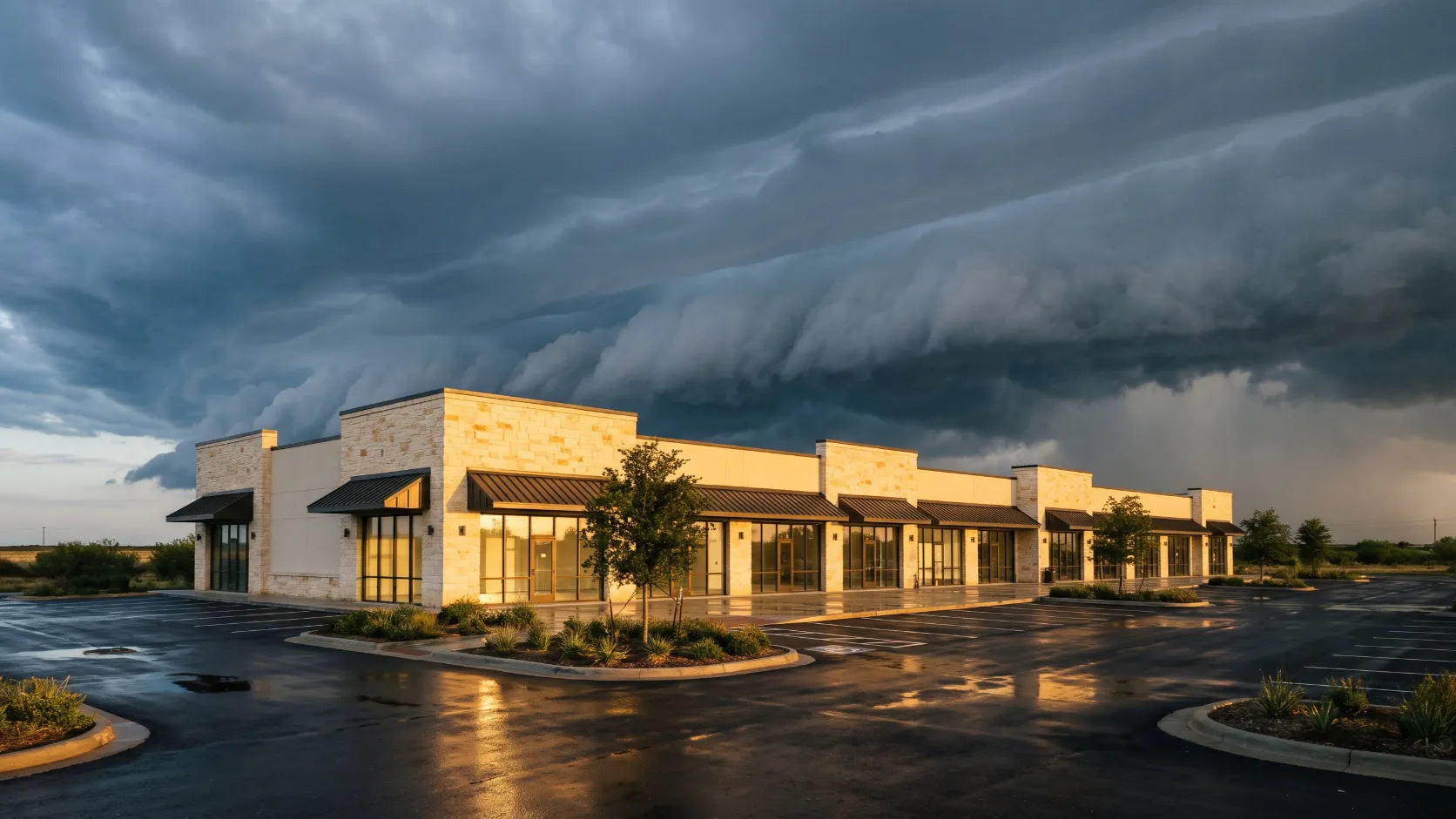
A storm shelf cloud approaching a Texas commercial building in the last evening light

Seven regions. Seven ways to test a policy.

Choose a region to see its main perils and what we watch for.

Choose a Region

Each region has its own perils — and its own policy fine print.

Hail

Texas had more major hail events (hail 1 inch or larger) than any other state in 2025, according to the Insurance Information Institute using NOAA data — and North and Central Texas see much of it.

Most Texas property policies carry a separate wind & hail deductible, often 1%, 2% or 5% of each building's insured value — not of the claim.

Older roofs are increasingly paid at actual cash value (after depreciation), and metal roofs often carry a cosmetic-damage exclusion.

What to do: know your roof ages and materials, compare how each quote pays for roofs, and model the deductible in dollars.

Hurricanes, Named Storms & TWIA

Coastal properties face named-storm deductibles, usually a percentage of insured value.

In the 14 first-tier coastal counties — Aransas, Brazoria, Calhoun, Cameron, Chambers, Galveston, Jefferson, Kenedy, Kleberg, Matagorda, Nueces, Refugio, San Patricio and Willacy — and areas of Harris County east of Highway 146 in La Porte, Morgan's Point, Pasadena, Seabrook and Shoreacres, private carriers may exclude wind. The Texas Windstorm Insurance Association (TWIA) is the state's wind insurer of last resort there.

TWIA generally requires a windstorm certificate of compliance for new construction, additions and repairs.

What to do: confirm who covers wind, line up TWIA and private policies so they fit together, and keep windstorm certificates on file.

Flood

Standard commercial property policies exclude flood — whether it's storm surge, an overflowing creek or a flash flood.

The National Flood Insurance Program (NFIP) covers non-residential buildings up to $500,000 and contents up to $500,000; for apartment buildings with five or more units the limits are $500,000 for the building and $100,000 for contents. Larger properties often add excess or private flood.

NFIP policies usually take 30 days to start, so they can't be bought when a storm is already forecast.

What to do: check your flood zone and elevation, but decide on flood coverage deliberately — many Texas flood losses happen outside high-risk zones.

Freeze

Winter Storm Uri in February 2021 caused burst pipes and sprinkler leaks across the state, including in buildings that had never frozen before.

Vacancy clauses, protective-safeguard conditions (like keeping heat on and sprinklers monitored) and water-damage deductibles all affect freeze claims.

What to do: keep heat and alarm monitoring on in vacant spaces, know your water-damage deductible, and add equipment breakdown for boilers and chillers.

Wildfire

The 2024 Smokehouse Creek fire in the Panhandle was the largest wildfire in Texas history.

Properties next to open land, in the Panhandle, West Texas and the Hill Country, face growing underwriting scrutiny.

What to do: keep clearance around buildings, document it, and check your debris-removal and business income limits.

Questions

Straight answers.

What is a percentage wind and hail deductible?

It's a deductible calculated as a percentage of each building's insured value, rather than a flat dollar amount. A 2% deductible on a building insured for $4 million is $80,000 per occurrence.

Which Texas counties can use TWIA?

TWIA serves the 14 first-tier coastal counties — Aransas, Brazoria, Calhoun, Cameron, Chambers, Galveston, Jefferson, Kenedy, Kleberg, Matagorda, Nueces, Refugio, San Patricio and Willacy — plus areas of Harris County east of Highway 146 within the city limits of La Porte, Morgan's Point, Pasadena, Seabrook and Shoreacres. Generally a private insurer must decline the property first.

Does commercial property insurance cover flood in Texas?

No. Standard commercial property policies exclude flood. Flood is bought separately through the NFIP (up to $500,000 for the building and $500,000 for contents for non-residential buildings) or private and excess flood markets.